



|
Getting your Trinity Audio player ready...
|
Key facts:
- Children leaving home and retirement are the most common triggers for downsizing
- Less living space often means more freedom, comfort and financial flexibility.
- Professional support reduces emotional and organizational hurdles.
The departure of children or retirement changes the housing needs of many homeowners. The question often arises as to whether the previous home is still suitable for the current stage of life. In Switzerland, many owners aged 60 and over live in owner-occupied homes with more living space than they need, as data from the Federal Statistical Office shows. The move to a smaller home often creates more comfort and freedom.
What does downsizing mean?
Downsizing describes the conscious decision to reduce or simplify living space. This does not just mean fewer square meters, but above all a form of housing that better suits current needs: easier to care for, less barrier-free, more centrally located or closer to medical care, infrastructure or family. In many cases, downsizing is not preceded by pressure, but by an active decision for a better quality of life and fewer obligations.
Why do owners opt for downsizing?
The children’s departure as a turning point
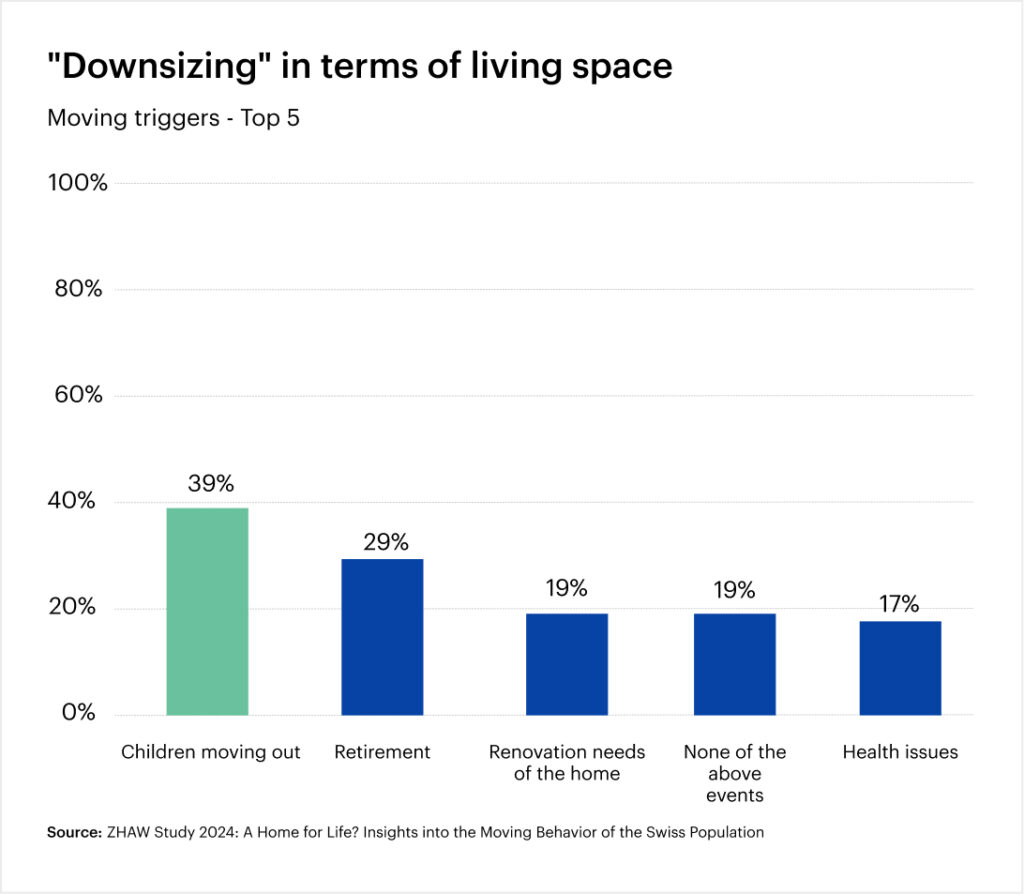
Statistics clearly show that the most common trigger for a change of residence is when the children move out. Around 39% of homeowners cite this step as the main reason for a change in living situation. Rooms are suddenly empty, while maintenance and upkeep of the house remain unchanged.
New priorities in retirement
With retirement, everyday life and financial structure change. Commuting is no longer necessary, leisure time becomes more important, and living location and comfort become more important. A smaller apartment in a well-connected location can make everyday life much easier.
Maintenance, renovations and health Many single-family homes require major investments as they get older: Roof, heating or facade. At the same time, physical strain – such as gardening or stairs – can become a challenge. Downsizing noticeably reduces this effort.
Gain financial flexibility
A sale can release tied-up capital. This capital creates room for maneuver: for travel, retirement planning, supporting the family or simply for more financial security. Studies show that home ownership accounts for the majority of wealth for many households, and downsizing can unlock this potential.
The emotional side of moving home
A house is more than just an object. It is a place of remembrance, family history and identity. This is precisely where many owners face the biggest hurdle when downsizing. Doubts, uncertainty or the feeling of “giving something up” are normal.
The perspective is crucial: downsizing does not mean saying goodbye to the past, but making room for something new. A home that supports rather than burdens. Less responsibility – more time for what really matters.
What forms of housing are in demand for downsizing?
- Central condominiums with elevator and short distances
- Barrier-free new builds or age-appropriate existing properties
- Rental solutions with service offerings that provide flexibility
- Smaller condominiums that preserve assets and offer comfort at the same time
The Swiss market offers significantly more options today than it did ten years ago. According to market analyses by UBS, demand for compact, well-located apartments in the 60+ segment is rising continuously.
Prepare downsizing well: Safety creates peace of mind
A successful change of home starts with clarity. These include:
- A realistic assessment of the current property value
- the analysis of tax aspects (e.g. property gains tax)
- a clear timetable for sale and relocation
- early discussion of housing alternatives
Digital tools such as a free property valuation offer initial guidance. However, personal advice that combines market knowledge with an understanding of the individual situation is crucial.
Downsizing is not a sign of doing without, but an expression of consciously shaping your life. Those who come to terms with their own needs at an early stage create new freedom – financially, organizationally and emotionally.
The right time is individual. The key is to take the step well informed and accompanied. Because a home should fit your life, not the other way around.
FAQ
When is the right time to downsize and sell?
The right time usually results from changes in life circumstances – for example, after the children move out, when maintenance costs increase or when location and comfort become more important than living space. Early planning creates freedom of choice and reduces time pressure.
How is the value of the existing property realistically assessed?
A well-founded property valuation takes into account the location, condition, market environment and comparable properties. Digital valuations provide an initial orientation, but a professional valuation is recommended for sales decisions in order to set realistic asking prices in line with the market.
What costs and taxes are incurred on the sale?
Among other things, property gains tax, notary fees and land registry costs may be incurred on the sale. The amount depends heavily on the holding period, canton and municipality. Early clarification helps to avoid financial surprises and to plan the net proceeds correctly.
How can the sale and change of residence be sensibly coordinated?
Coordinated planning of the sale and home search is crucial. In many cases, the first step is to clarify the sale proceeds in order to determine the budget and time frame for the new home. Professional support facilitates this coordination and ensures a smooth transition.