


Key facts:
- Sustainable properties sell faster and achieve higher market prices
- Up to CHF 6/m² more willingness to pay for well-insulated rental apartments
- 56% of tenants would participate in solar systems – despite their tenancy
Whether selling or renting – sustainable properties are a success factor even in economically challenging times. Energy-efficient buildings, ecological heating systems and solar panels are not only more in demand than ever, they also have a direct impact on market value, rental price and marketing duration. Owners who design their property with long-term value in mind benefit – both ecologically and economically.
Buyers and tenants are rethinking – and investing consciously
A recent study by the University of St. Gallen in cooperation with renowned research institutes clearly shows that Swiss tenants are increasingly willing to pay more for sustainable forms of housing. On average, an additional CHF 4 per square meter is possible for well-insulated apartments – households with a monthly income of over CHF 9,000 are even willing to pay more than CHF 6 per square meter.
Even more exciting for landlords: 56% of respondents said they would be willing to participate in financing a solar installation on the roof – even though they do not own the property. This high level of identification with sustainable living signals a clear shift in market behavior.
Buyers are also paying more attention to ecological features and long-term savings potential – especially in times of rising energy costs and increasing regulatory requirements.
Sustainable real estate as a value driver – in sales and rentals
What does this mean for owners in concrete terms?
At the sale energy-efficient properties offer clear advantages: on average, they achieve higher prices as the operating costs are lower and the long-term value is better assessed. They also stand out from the competition – especially in urban markets, where sustainability is perceived as a quality feature.
Sustainable properties are doubly interesting when it comes to letting: on the one hand, tenants are more willing to pay, which means a better return can be achieved; on the other hand, modern fittings and lower ancillary costs reduce fluctuation – a real advantage for long-term investors and tenants alike.
Energy efficiency: What really counts?
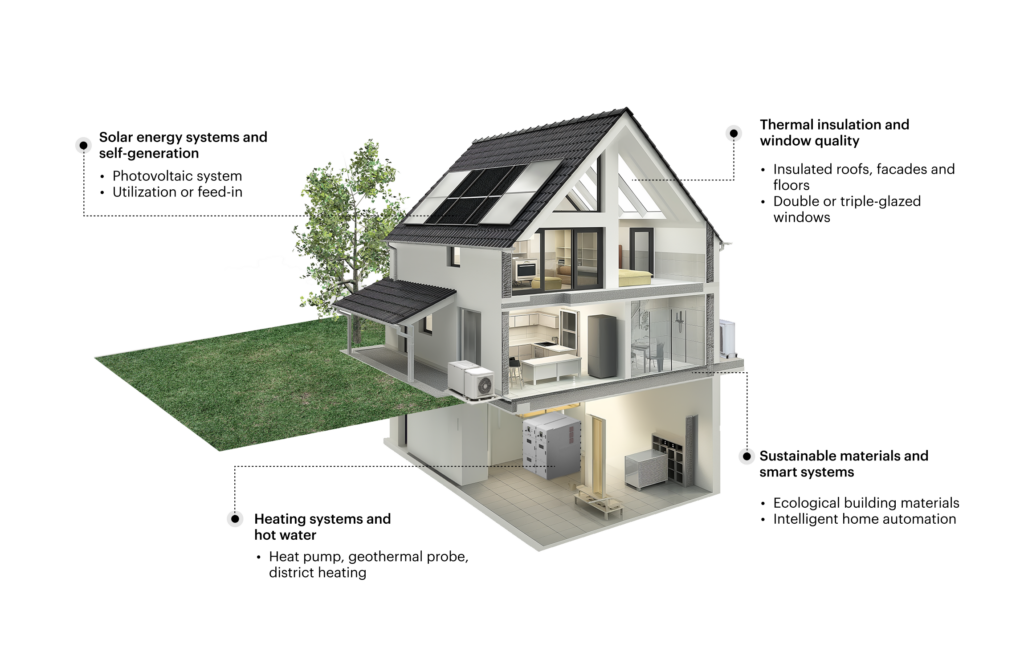
Interested parties – whether buyers or tenants – no longer evaluate properties solely on the basis of location, floor plan and fittings. Energy quality is becoming a key decision-making criterion. These four factors are particularly in focus:
1. thermal insulation and window quality
A good building envelope not only reduces heating requirements, but also ensures a pleasant indoor climate. Double or triple-glazed windows, professional façade insulation and insulated roofs and floors are crucial for the energy efficiency of a building. Potential buyers and tenants are increasingly paying attention to these aspects – not only because of the cost savings, but also because of the comfort and carbon footprint.
2. heating systems and hot water preparation
Outdated oil or gas heating systems are perceived by many as critical – also with regard to future refurbishment obligations or government intervention. Modern systems such as heat pumps, geothermal probes or connection to a district heating network are now considered the standard for sustainable residential properties. Solutions such as central water heating with solar thermal energy or the combination with photovoltaic modules also score points.
3. solar systems and own electricity production
Having your own photovoltaic system on the roof not only increases the attractiveness of the property, but also provides additional independence from electricity prices. Buyers appreciate the option of using their own electricity or feeding it into the grid. Tenants are also very interested – especially if they can benefit directly from the electricity generated through so-called “tenant electricity models”.
4. sustainable materials and smart systems
More and more interested parties are attaching importance to building materials with a low ecological footprint, such as wood from sustainable forestry, clay plaster or recyclable insulation materials. This is complemented by smart technologies: Intelligent thermostats, digital energy meters and automated ventilation systems not only increase living comfort, but also help to actively control and optimize energy consumption.
Regulatory tailwind: subsidies for owners
Switzerland supports owners in the sustainable transformation of properties with numerous subsidy programs, tax breaks and advice. At both cantonal and communal level, investments in energy-efficient renovations or new builds are given positive incentives. Platforms such as SwissEnergy offer comprehensive information on current support models.
At the same time, regulatory pressure is growing. Environmental standards such as Minergie are gaining acceptance, and European guidelines such as the French RE2020 are increasingly influencing Swiss building culture. Sustainability is thus evolving from a voluntary bonus to a market standard.
Conclusion: Sustainability as the key to value, demand and future security
Sustainability has long been more than just an additional selling point – it is becoming a competitive advantage on the real estate market. Investing in sustainable measures today creates long-term added value – be it through higher sales prices, more attractive rental yields or stable demand.
Owners who make their property fit for the future are not only acting in the interests of the environment – but also in the interests of a successful sale or profitable rental.
Sustainability is not a trend – it is the new standard. Those who invest now will benefit twice over.
Data are without guarantee. The information on these Internet pages has been carefully researched. Nevertheless, no liability can be assumed for the accuracy of the information provided.